Case Number 1
Date:
14/07/2026
Case Title
Recurrent sudden-onset severe headaches
History of Present Illness
A 49-year-old previously healthy woman presented with recurrent episodes of sudden-onset, severe, pulsatile headaches reaching maximal intensity within seconds.
The first episode occurred shortly after swimming in the ocean and radiated from the occipital to frontal region. Symptoms improved over several hours with analgesics.
Two days later, she experienced a second similar episode while shopping, this time associated with transient left-sided facial numbness. There were no associated visual disturbances, weakness, speech difficulty, or loss of consciousness.
She denied recent trauma, neck pain, positional triggers, fever, weight loss, or systemic symptoms.
The first episode occurred shortly after swimming in the ocean and radiated from the occipital to frontal region. Symptoms improved over several hours with analgesics.
Two days later, she experienced a second similar episode while shopping, this time associated with transient left-sided facial numbness. There were no associated visual disturbances, weakness, speech difficulty, or loss of consciousness.
She denied recent trauma, neck pain, positional triggers, fever, weight loss, or systemic symptoms.
Past Medical History
No significant past medical history
Medications
• No prescribed medications
• Intermittent use of NSAIDs and acetaminophen for headache relief
• Recent use (6 months) of herbal supplement: Ashwagandha (dose unknown)
• Intermittent use of NSAIDs and acetaminophen for headache relief
• Recent use (6 months) of herbal supplement: Ashwagandha (dose unknown)
Allergies
• No known drug allergies
Family History
• Non-contributory (no known neurological or vascular disorders)
Social History
• Non-smoker
• Does not consume alcohol
• Occasional recreational swimming
• No recreational drug use
• Does not consume alcohol
• Occasional recreational swimming
• No recreational drug use
Review of Systems
• Unremarkable
Examinations
• Vital Signs:
– Blood pressure: 133/85 mmHg
– Heart rate: 92 bpm
– Afebrile
• Neurological Examination:
– Cranial nerves: intact except decreased light touch over left face
– Motor strength: normal
– Coordination and gait: normal
– No focal deficits aside from sensory finding
– Blood pressure: 133/85 mmHg
– Heart rate: 92 bpm
– Afebrile
• Neurological Examination:
– Cranial nerves: intact except decreased light touch over left face
– Motor strength: normal
– Coordination and gait: normal
– No focal deficits aside from sensory finding
Investigation
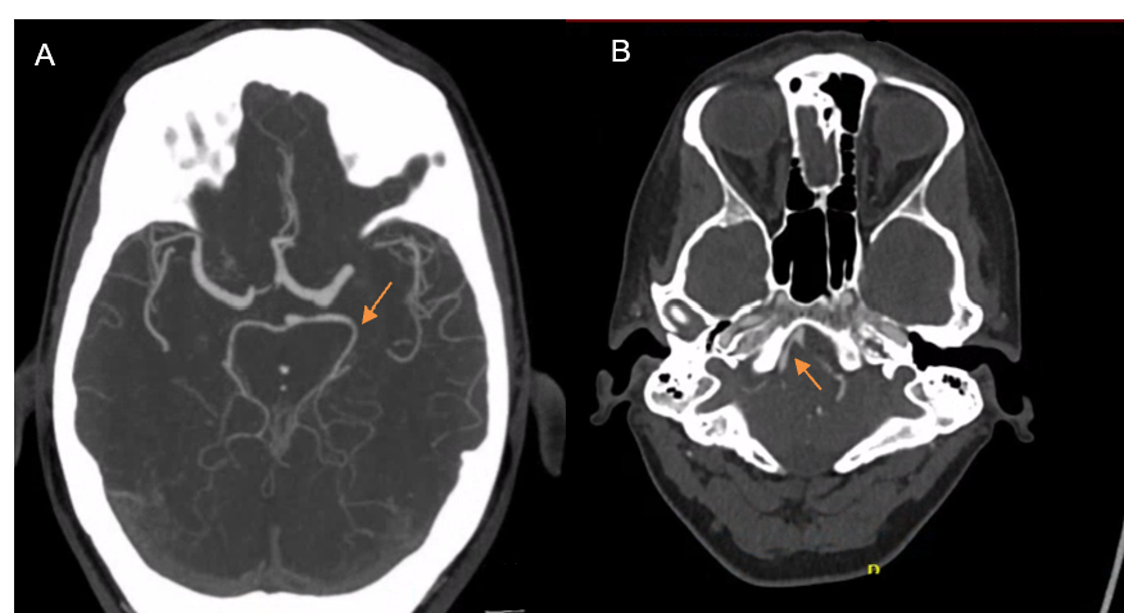
Brain CTA obtained during second presentation with thunderclap headache demonstrating arterial narrowing at left P2 branch of posterior cerebral artery (a) and arterial narrowing of the right V4 segment of vertebral artery (b). Note: Right hypoplastic A1 was an incidental finding.
CTA: computed tomography angiography
CTA: computed tomography angiography
Investigation Images
Laboratory Tests
• Normal metabolic panel
• Negative inflammatory markers and vasculitis panel
• Blood cultures: negative
• Negative inflammatory markers and vasculitis panel
• Blood cultures: negative
Diagnosis
Reversible Cerebral Vasoconstriction Syndrome (RCVS)
Discussion
This case describes reversible cerebral vasoconstriction syndrome (RCVS) occurring in association with both cold-water exposure and Ashwagandha use, suggesting a possible combined triggering effect. While cold exposure is a recognized but uncommon cause of cerebral vasospasm through sympathetic activation, the patient’s prior tolerance of cold-water swimming raises the possibility that Ashwagandha lowered the threshold for vasoconstriction. Although causality cannot be definitively established from a single case, the lack of alternative triggers and emerging reports linking Ashwagandha to neurovascular events support a potential association. The herb contains multiple bioactive compounds with poorly understood effects on vascular tone, complicating mechanistic understanding. Given the increasing use of herbal supplements, clinicians should carefully assess for such exposures in patients with RCVS and consider their potential role, while further research is needed to clarify these associations.
Reversible Cerebral Vasoconstriction Syndrome (RCVS) is a cerebrovascular disorder characterized by recurrent thunderclap headaches and transient, multifocal segmental vasoconstriction of cerebral arteries that resolves within 3 months (2,3).
Authors
Dr. Setareh Lahsaee, MD, FRCPC, Department of Medicine (Neurology), Dalhousie University, Halifax, Nova Scotia, Canada
Editor
Editorial Team
References
1. Patel PA, Sanborn E, Then R, Williams DM. Recurrent reversible cerebral vasoconstriction syndrome: a report of two cases. Cureus. 2023;15(8):e42992.
2. de Sousa ÍA, Machado ADS, Veras AO, et al. Reversible Cerebral Vasoconstriction Syndrome: A Narrative Review. Headache. 2026. doi:10.1111/head.70048.
3. Singhal AB. Reversible Cerebral Vasoconstriction Syndrome: A Review of Pathogenesis, Clinical Presentation, and Treatment. International Journal of Stroke
2. de Sousa ÍA, Machado ADS, Veras AO, et al. Reversible Cerebral Vasoconstriction Syndrome: A Narrative Review. Headache. 2026. doi:10.1111/head.70048.
3. Singhal AB. Reversible Cerebral Vasoconstriction Syndrome: A Review of Pathogenesis, Clinical Presentation, and Treatment. International Journal of Stroke